The OSDT Equipment Guide: Every Rig We Fly and Why
From the Avata 2 on a residential listing to the ShenDrones cinelifter on a production day. The full kit, organized by what it's actually used for.
Gear is a means to an end. The rig that lands on a Charlotte listing isn’t chosen because it’s the most expensive or the most technically impressive. It’s chosen because it’s the right tool for what that specific shoot needs to produce. A residential FPV tour calls for something different than a production day for a music video, and both call for something different than the aerial photo pass on a commercial listing.
Here’s the full kit, organized by use case.
FPV rigs: residential and commercial
DJI Avata 2
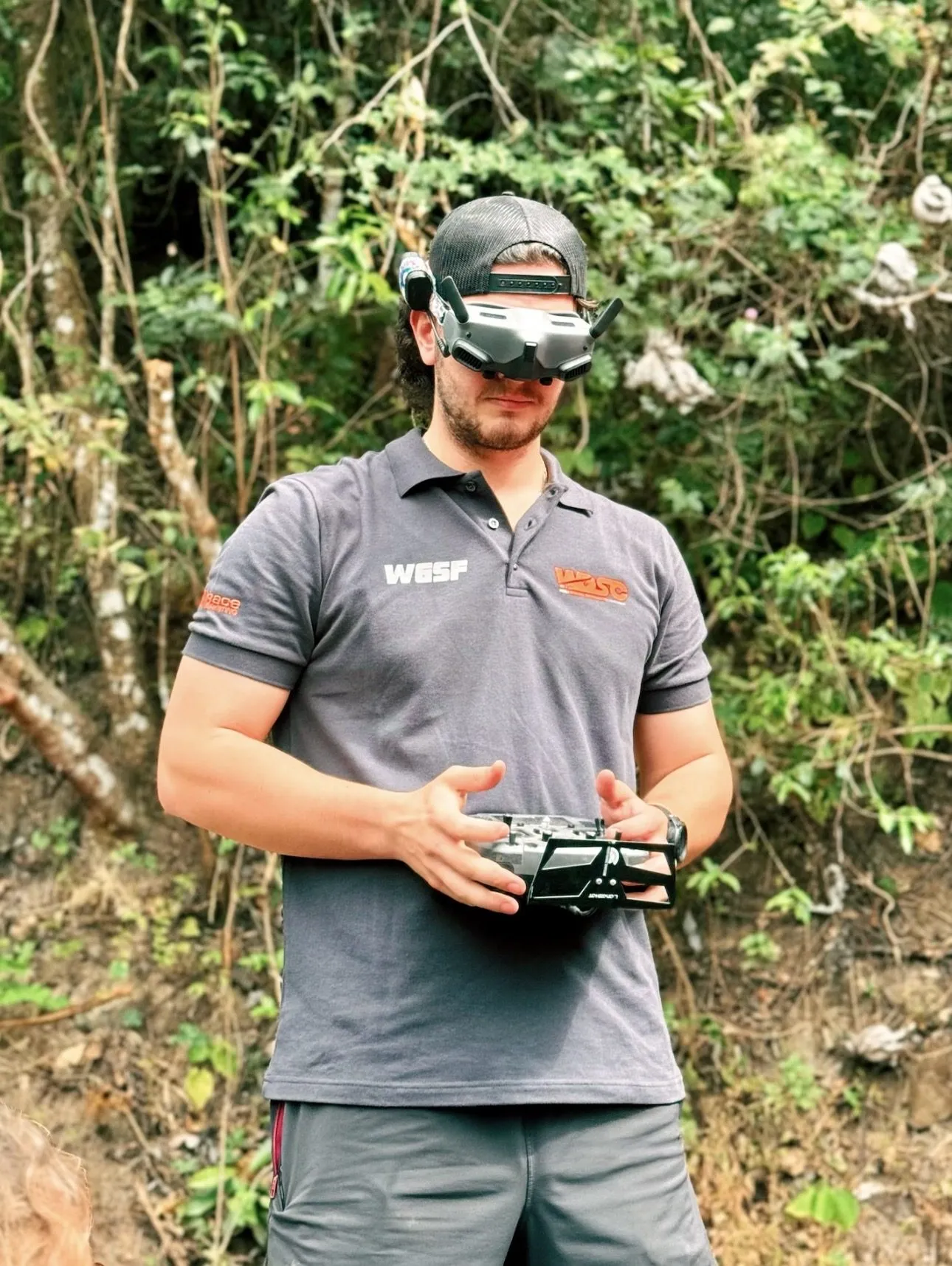
The Avata 2 is our most-deployed residential rig. It flies on DJI’s proprietary O4 video link with the DJI Goggles 3 and Remote Controller 3, a closed ecosystem that’s less tuneable than a custom build but considerably more forgiving in tight spaces. The props are ducted, which means the blades are enclosed in a ring that protects both the drone and whatever it’s flying near. It self-stabilizes when the pilot releases the sticks.
For listings with simpler single-level layouts, soft furnishings close to the flight path, or any scenario where the risk profile calls for the safer rig, the Avata 2 is what goes in the case. The image quality is strong (the onboard camera records log 4K) and the flight characteristics are predictable enough that a well-planned route runs cleanly on the first take.
We run multiple Avatas. One is primary, one stays as a hot backup on every job.
Spydr iTSY Evo with DJI O4 Pro
The iTSY Evo is our workhorse for complex shoots. It’s a sub-3-inch ducted cinewhoop frame, smaller and faster than the Avata, with tighter turning radius and more aggressive flight characteristics that let it handle multi-level transitions, narrow hallways, and layouts where the Avata’s size or momentum would create problems.
The camera is a DJI O4 Pro air unit mounted to the nose of the frame, recording log 4K directly onboard. One camera, one file. No separate action camera, no sync. The O4 Pro also provides the live video feed to the pilot’s goggles on the same link, so what the pilot sees and what the sensor records are the same image path.
All our custom builds run on ELRS (ExpressLRS, an open-source long-range radio protocol with sub-1ms latency). The transmitter is a RadioMaster GX12, a compact multi-protocol radio that we use across all non-DJI aircraft. Custom-built and tuned in-house on 3S 720mAh LiHV packs.
Sub250 Huma20
The Huma20 is a sub-250-gram micro, light enough that the regulatory footprint is smaller and the platform is genuinely useful in spaces where even the iTSY feels large. Sub-250g aircraft aren’t exempt from Part 107 requirements when flown commercially, but the weight class opens up certain operational flexibility that heavier rigs don’t have. Good for tight interiors, courtyard shots, and scenarios where we want an almost imperceptible aircraft in the frame.
ShenDrones Squirt with GoPro
When the brief calls for GoPro color (wide dynamic range, the specific look that performs on certain social platforms), the Squirt is the frame we reach for. It’s designed around a GoPro as the primary camera, with a layout that protects the lens and provides clean feed to the goggles via a separate FPV camera up front. The resulting footage has the GoPro’s characteristic color science and field of view, which some production clients specifically request.
FPV rigs: production
Straw Hat Sam Vulture with Blackmagic G2
The Vulture is a production FPV frame purpose-built to carry a Blackmagic G2 cinema camera. Not an action camera, not an air unit, but a proper cinema sensor. This is the rig for production work where the colorist needs raw latitude and the edit is going to carry the footage through a full grade. The Blackmagic G2 records in BRAW, Blackmagic’s proprietary raw format, which retains significantly more data than any action camera or air unit codec.
The tradeoff is everything you’d expect from flying a cinema camera: the rig is heavier, the flight dynamics are different, and the margin for error on a crash is zero. This aircraft lives on production days with a full brief and rehearsed flight paths, not listing shoots.
ShenDrones Cinelifter
The ShenDrones cinelifter is the heavy-lift platform in the fleet, built for larger cinema camera payloads, extended aerial sequences, and shots that need more altitude stability than a cinewhoop can provide. Where the Vulture handles aggressive FPV moves with a cinema camera, the cinelifter handles the slow, controlled aerials that require precise gimbal-stabilized movement at altitude.
Production days that involve both an FPV sequence and a cinematic aerial component often involve both rigs: the cinelifter for the wide establishing material, the Vulture or a cinewhoop for the dynamic interior or low pass work.
Real estate photography and aerial stills
DJI Mini 5 Pro, Air 3, Air 3S
The Mini 5 Pro, Air 3, and Air 3S cover the aerial photography side of residential packages. These are the aircraft that produce the exterior stills in a Standard package: the high orbit, the descending reveal, the backyard sweep. They’re gimbal-stabilized, GPS-locked, and built specifically for the kind of controlled, precise aerial photography that listing media requires.
The Air 3 and Air 3S carry dual cameras (main + telephoto), which gives us flexibility on compression and framing from altitude that a single-lens platform doesn’t. The Mini 5 Pro stays sub-250g, which is useful in airspace situations where a lighter aircraft opens up authorization options.
Aerials for listing stills fly at 150–250 feet on a typical Charlotte property. We’re well inside LAANC ceilings on most residential shoots.
DJI RS 3 Pro
The RS 3 Pro is a 3-axis motorized gimbal stabilizer. It holds a mirrorless camera body and eliminates shake during ground-level video. We run two of them. On shoots that include ground-level video (walkaround, interior walkthrough b-roll for an Elite cinematic video), the RS 3 Pro is what keeps the camera steady while the operator moves through the space.
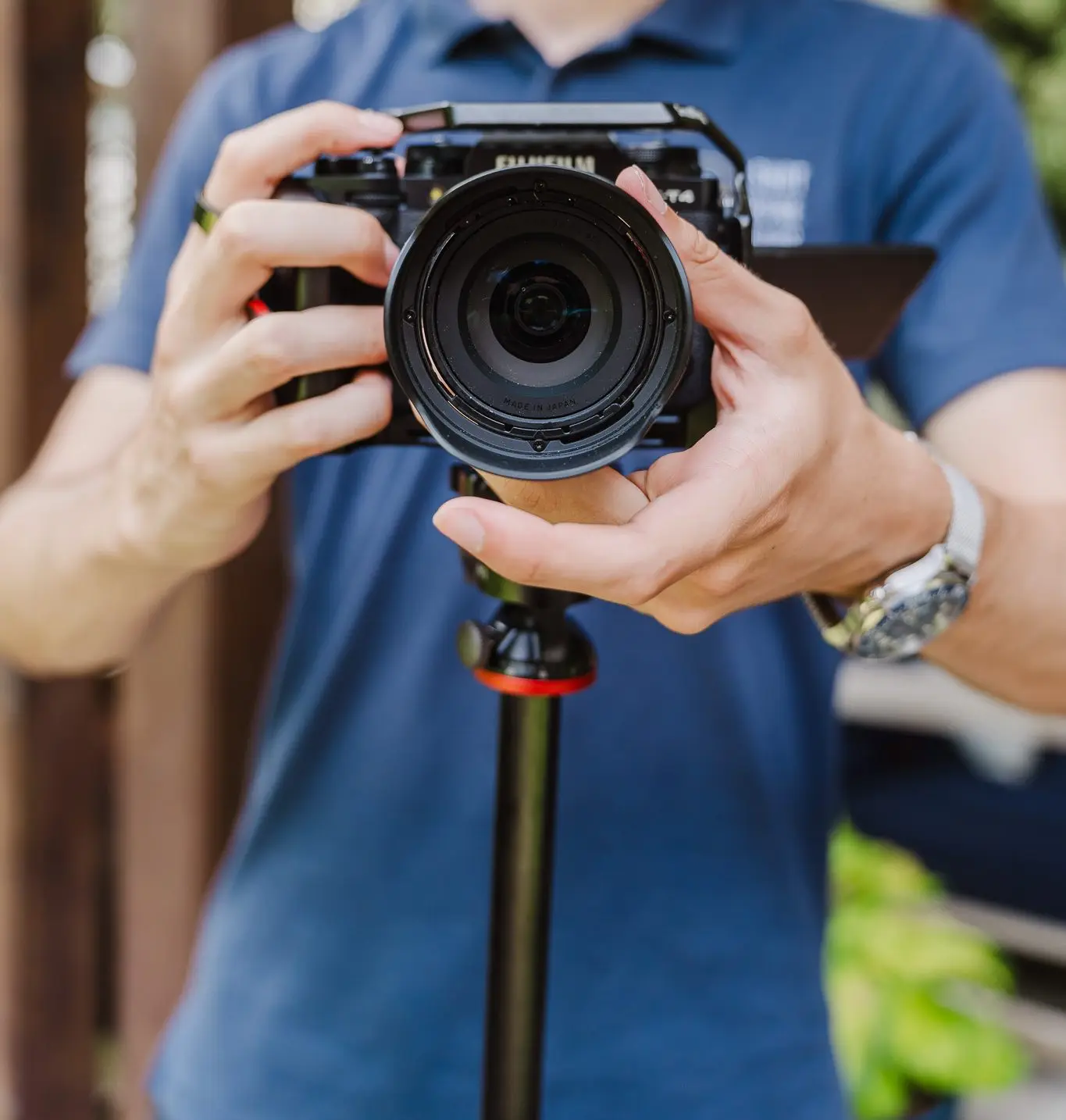
Fujifilm X-T4 + Fujinon 10-24mm f/4
Both X-T4 bodies are paired with the Fujinon XF 10-24mm f/4 R OIS, a wide-angle zoom that covers the full range of interior photography in a single lens. The 10-24mm focal length on APS-C is the right tool for rooms: wide enough to capture a full kitchen or living room without the distortion of an ultra-wide, compressed enough at 24mm to isolate detail shots without a lens change.
The X-T4’s sensor handles the mixed lighting conditions of a Charlotte listing (large windows, interior artificial light, varying color temperatures) with enough dynamic range to preserve window detail and interior exposure in the same frame when the light cooperates.
CPL filter
A circular polarizer filter goes on the lens for exterior and window-adjacent MLS photos. CPL cuts polarized reflections from glass, water, and wet surfaces, particularly useful for listings with large windows where interior reflections compete with the exterior view, and for pool or water feature shots where glare reads as noise. One of those small pieces of glass that makes a repeatable difference.
Software and editing stack
Final Cut Pro. Video edit for all deliverables. MLS cuts, social cuts, cinematic property videos. Timeline, color, export all in Final Cut.
Imagen + Nano Banana + Lightroom. The full photo editing pipeline. Imagen and Nano Banana are both AI-powered editing tools (Imagen is Google’s, Nano Banana is purpose-built for photography workflows) and both are trained on OSDT’s past edits so the output stays consistent across jobs and operators. Lightroom handles catalog management, final export settings, and any manual corrections the AI flags for review.
CubiCasa. Floor plans, generated from LiDAR scans using pro iPhones on-site. The app walks the space, the LiDAR builds the point cloud, and CubiCasa renders a clean 2D plan that’s MLS-ready and accurate to within a few inches on a typical listing.
Field infrastructure
Pelican cases. Every rig that leaves the shop travels in a Pelican. Custom foam cuts for each aircraft, batteries stored separately per transport regulations. If it’s in the field, it’s in a case.
MacBook Pros. Editing and delivery on site when needed. Most edits go back to the shop, but longer production days sometimes call for on-site review.
iPad (live feed). On residential and larger shoots, an iPad gives the team a live feed preview without the setup overhead of a full monitor rig. On production days, dedicated field monitors come out for on-set review.
Oben tripods. The platform for X-T4 stills work when the shot needs a fixed, level base. Particularly for any composition that benefits from a locked frame.
The gear list evolves. New rigs get added as the work warrants and as better tools come available. What doesn’t change is the workflow: the right aircraft for the brief, custom-built and tuned where the job calls for it, backed up on every job, and flown by a Part 107 team that’s logged thousands of hours across the full kit. The regulations and insurance post covers the compliance side of operating this equipment commercially. The FPV tour playbook covers specifically how the residential rigs get deployed on a listing shoot.
Related journal posts
FPV Drone Tours for Charlotte Real Estate: The Full Playbook
A field guide to FPV drone tours for Charlotte listings: how we plan the route, direct the agent, pick the gear, and deliver the MLS and social cuts. Specifics, not sales copy.

Drone Regulations + Insurance: What Clients Should Actually Ask About
A direct explainer on drone regulation and insurance. Part 107, Remote ID, LAANC, liability limits, and what a COI means for your shoot. Written for clients, not pilots.

Can You Legally Fly a Drone at My Charlotte Address?
Most of Charlotte's inner ring sits under CLT's Class B shelves. Here is what that means for shooting your property, and why it is usually a scheduling question rather than a legal one.