Filming a Room That Was Designed Well: Open Tap and the Case for Brewery FPV
Open Tap works because four different kinds of visit happen in one building without stepping on each other. Photos break that apart. A continuous flight is the only way to show it holding together.
Here is the thing photos do to a well-designed bar: they take it apart.
You get a shot of the tap wall. A shot of the patio. A shot of the mezzanine, a shot of the food truck, a shot of some string lights at dusk. Every one of them can be a good photograph, and the set still fails, because the person looking at it comes away thinking they have seen five different places. What they have not seen is the thing the designer actually built, which is how those five places connect.
Open Tap in south Charlotte is the clearest example of that problem we have shot.
What Scott actually wanted
Open Tap sits on Carmel Center Drive. Scott and Brooke Thorne built it with the old log cabins of the Carolinas in mind and then dragged that reference somewhere contemporary: wood-slat exterior, a treehouse mezzanine, a shade garden, a turf village green, a food truck stall built into the site, and a garage door that opens the indoor room straight onto the outdoor one. 64 taps inside. Roughly 7,500 square feet once you count the parts without a roof.
When Scott talked about what he wanted from the content, it was not “show the taps.” It was closer to: show that this works.
Because the real accomplishment at Open Tap is that four completely different visits happen in the same building at the same time without any of them ruining the others. A family is out on the green while the kids run around. Two people are having an actual conversation at the mezzanine rail. Somebody is alone with a beer and a phone. A group of six has colonized a food truck table. In a badly designed venue those four groups are in conflict and at least three of them leave early. At Open Tap they blend, and the blending is deliberate, and it is very hard to photograph.
Continuity is the format
This is the part that makes FPV the right tool rather than just a stylish one.
A still frame can only ever show one zone. Cut between stills and the viewer’s brain reads them as separate rooms, possibly separate businesses. Even a well-edited gimbal video has cuts, and every cut is a small claim the viewer has to take on faith: trust me, this patio is attached to that bar.
An unbroken flight makes no claims. It just goes. Out of the taproom, through the open garage door, over the turf where the kids are, past the food truck, back in under the mezzanine. The connection is not asserted, it is demonstrated, because the camera never stopped moving and never cut. Twenty seconds and the viewer understands the floor plan, the vibe, and the fact that they can bring their kids without it being weird.
That is worth being specific about, because “cinematic” gets thrown at FPV as though the value is that it looks cool. It does look cool. But the actual reason it outperforms in hospitality is structural: continuous motion is the only way video can prove spatial continuity, and spatial continuity is what a well-designed venue is selling.
Two passes, empty and full
Hunter shot Open Tap in two passes on the same visit.
The empty pass runs before service. It is the architectural one: clean lines down the tap wall, the mezzanine, the sightline from inside out through the garage door to the green. Nothing in frame competes with the building. This is the pass that ends up on the website and on Google, where the job is to show what the venue is.
The occupied pass came later, with the room moderately busy. Not shoulder to shoulder, which is the version of “busy” that photographs like a fire code violation, but the level a good Thursday actually looks like. People at the pour stations, families on the green, the food truck working.
Those cuts do different jobs. The empty pass sells the room, the occupied pass sells the night, and for a venue like this the occupied pass is the one that carries the argument, because the argument is about how people use the space. You cannot show four kinds of visit coexisting in an empty building. You can only show that it would be possible.
Venues that shoot only the empty version end up with a beautiful website and social content nobody finishes, because an empty bar reads as a closed bar in a feed. Venues that shoot only the busy version cannot show the layout, because there are bodies in front of all of it. Booking both in one visit is the cheap way to get both.
The outside is half the venue
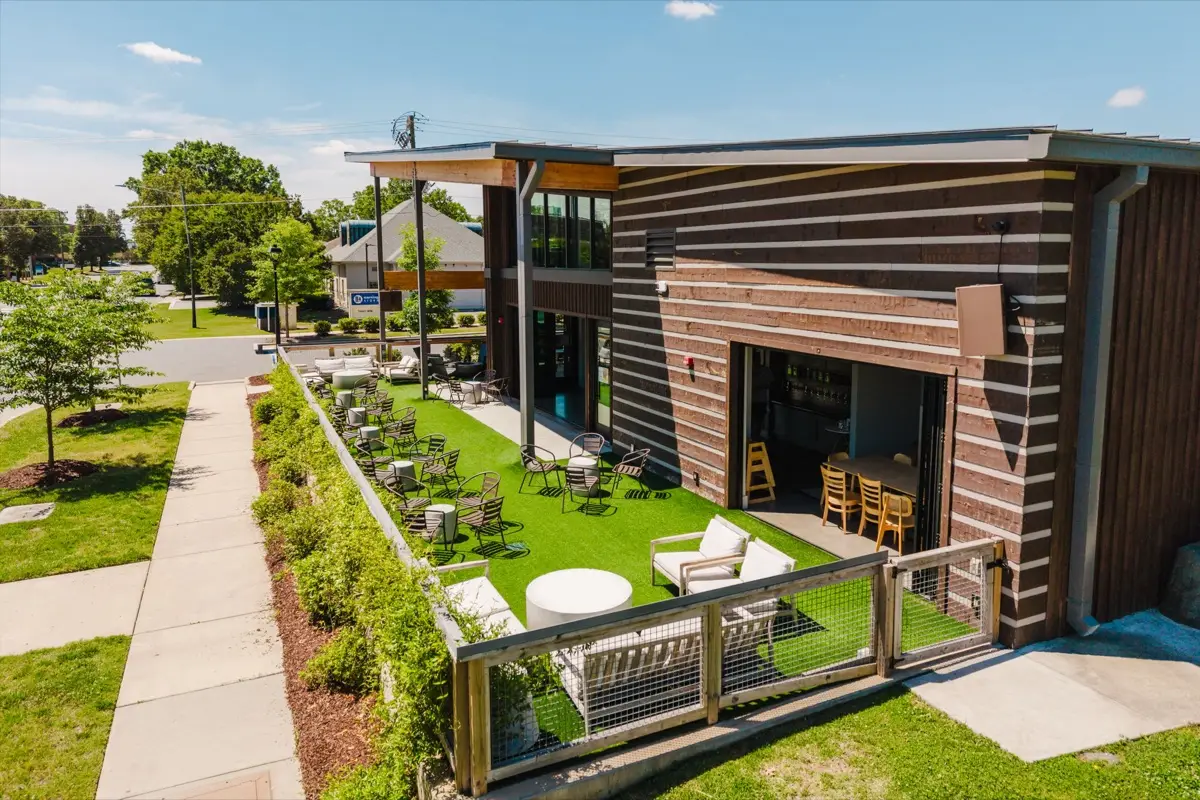
A large share of Open Tap has no roof over it, and none of that reads properly from inside, so we shot aerials the same day.
The hero image on this post is one: the green, the seating, the open garage door that makes the indoor and outdoor halves read as a single room. That last detail is the entire design thesis of the building visible in one frame, which is why it is the shot worth having.
Operators with real outdoor footprints tend to undervalue this. A parent deciding where to spend Saturday afternoon is asking one question, which is whether there is somewhere safe for the kids to be, and an interior photo set cannot answer it. The aerial answers it in about a second. Pairing FPV inside with aerials outside is the complete picture for this kind of venue, and it is one visit rather than two vendors.
Flying a room with people in it
The rig for occupied hospitality is the Spydr iTSY Evo, a sub-3-inch ducted cinewhoop recording log 4K. Ducts around the props, small enough to move through a doorway without needing the doorway cleared. We do not fly open-prop aircraft near guests, and an operator who offers to is telling you something.
The work that makes an occupied flight look effortless happens before anyone presses record. Hunter walked the space first and logged the things that end flights: ceiling fans, the pendants over the bar, the height of the mezzanine rail, where the food truck power ran. The route gets rehearsed while the room is still empty, so the live pass is execution rather than decision making.
One wrinkle specific to a venue built like this. The best shot in the building is the transition through the open garage door, and it is also the hardest exposure in the building, because you are going from interior tungsten to full daylight in about a second and a half. Shooting the empty pass first is how you learn what that transition does to the image before the room is full and you get one attempt at it.
There is more on the rig hierarchy and why this class of aircraft is the tool for occupied spaces in the gear guide.
What a brewery shoot costs
Commercial FPV in Charlotte starts at $600 for a walkthrough on its own. Ground and aerial stills start at $400 each. All three together start at $1,000, which is where most brewery and taproom shoots land, because venues in this category almost always have outdoor space worth the aerials.
A two-pass shoot like Open Tap, empty and occupied in one visit, sits at the upper end of that once the second edit is in scope. Full pricing is on the pricing page, and commercial work is quoted per project rather than per hour.
Three booking notes for this category:
- Shoot the empty pass on a weekday morning. You want the room lit and staged before service, not scrambled between shifts.
- Give the occupied pass a real date. A “sometime busy” shoot is a bad shoot. Pick the night and tell staff a week ahead.
- Take the aerials if you have any outdoor space at all. For patio-heavy venues this is the shot that answers the question people are actually asking.
Good venue design is mostly invisible in photographs. The whole craft is in adjacency, sightlines, and how one area hands you off to the next, and none of that survives being cut into stills. Scott spent real money making Open Tap work as a single connected place. Filming it in pieces would have thrown that away.
If you run a taproom, brewery, or restaurant in Charlotte and want to scope a shoot, email contact@oneshotdronetours.com with the venue and the night you would want the occupied pass. The hospitality reels breakdown covers what this format has done for two other Charlotte venues, and the commercial page has the rest.
Related journal posts
Three 100k-View Reels and a 50k-View Walkthrough: What Platform Sports and Must Be Nice Did Right
Three Platform Sports reels cleared 100k views each. Must Be Nice hit 50k+ on a single 20-second clip and rebooked for a DJ set. What the numbers mean, and why this format keeps outperforming.
The OSDT Equipment Guide: Every Rig We Fly and Why
The complete OSDT equipment breakdown: FPV rigs, gimbal systems, cameras, radio links, editing stack, and field infrastructure. What we fly, what we shoot with, and the logic behind each choice.
The Commercial Drone Media Playbook for Charlotte CRE
How Charlotte CRE brokers, developers, business owners, and hospitality operators use FPV and aerial drone media to lease space, close deals, and fill seats, across all four commercial verticals.